Building Auditable RokDoc Plugins with AI
RokDoc AI Series | Part 4 of 5: Keep judgement with the person
What happens when there is no right answer for the machine to find?
The first three parts (Part one of five: Make the process explicit , Part two of five: Separate execution from judgement, and Part three of five: Make the work defensible) were Phase 0: necessary, unglamorous, and not why anyone bought the software. This one is the work people actually get paid for.
Same execution engine, different dataset. An onshore Permian project, fifteen wells on the C Ranch survey, two thousand log curves already loaded. The question is where the rock worth completing is.
Three things at once
In an organic shale the rock you want has to be three things simultaneously. Porous, so it can store. Organic rich, because that is the resource. And low in clay, so it can be completed.
Not any one of them, and not the best average of the three. An intersection. That is what makes it a real problem rather than an arithmetic one, because a well can be excellent on two counts and worthless on the third.
So the workflow cross plots porosity against volume of clay across every well, coloured by total organic carbon. A hundred and eleven thousand samples in one picture.
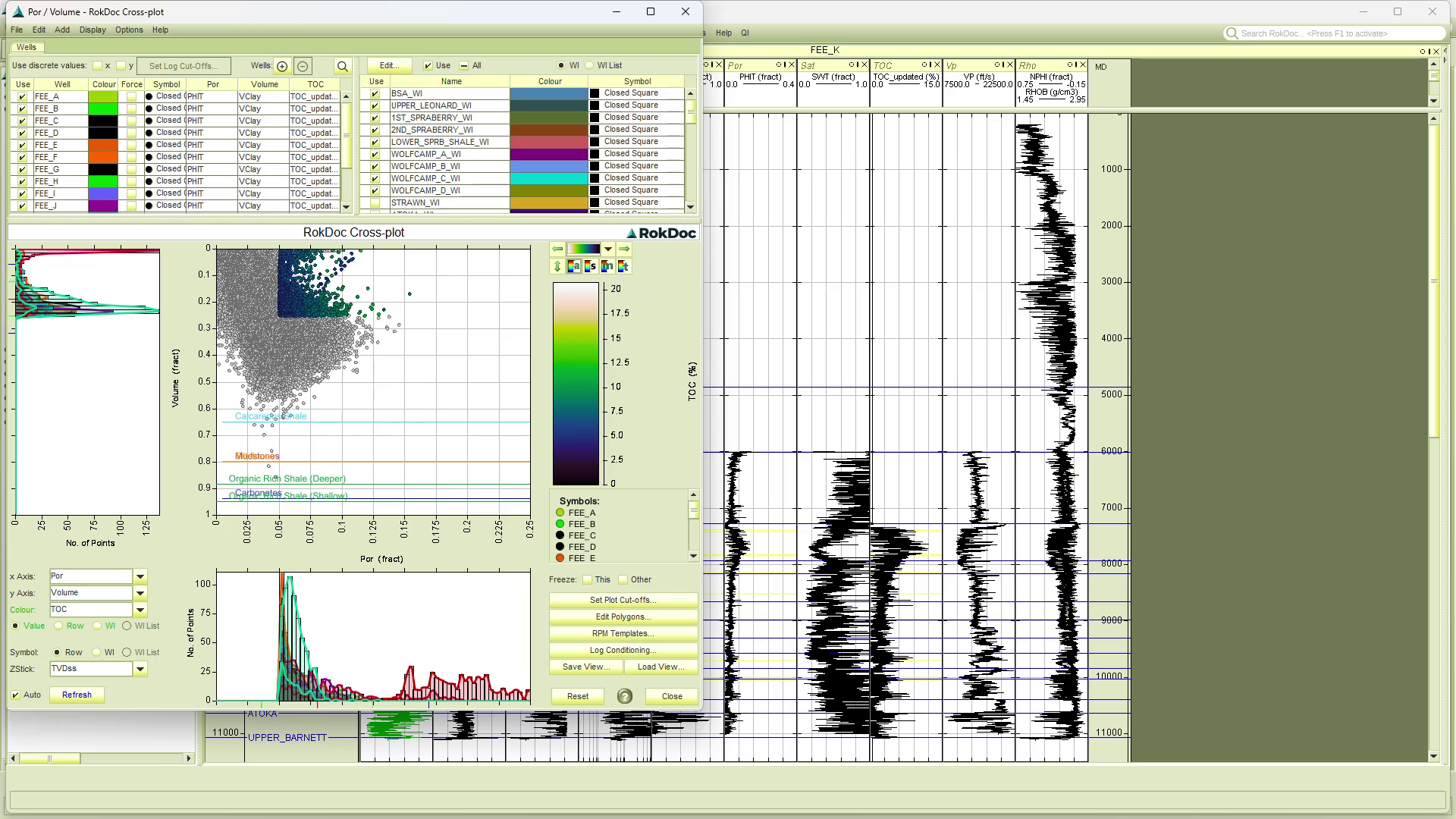
The cross-plot with cut-offs applied, the qualifying population picked out of the grey cloud and colour-graded by TOC.
The part that is a judgement, not a discovery
Then it has to choose where to cut, and this is the part worth watching, because there is nothing to discover.
All three logs are smooth. There is no natural break, no bimodality, no elbow in a histogram that says here is where good rock stops. Anyone who has done this knows the feeling of hunting for a threshold that is not there. The cut off is not a fact hidden in the data. It is a decision about how selective you are willing to be, and several answers are defensible.
That is exactly the kind of question people assume you cannot hand to a machine, and it is the most interesting thing in this run, because the machine did not answer it by pretending to find something. It framed the choice. It built three candidate sets, permissive, balanced and premium, computed what each one costs, and stated the trade off in the terms that decide it: the premium set survives in barely one percent of the package, too thin to map without several wells returning nothing. So it proposed the balanced set, said why, and put it up to be overridden.
The judgement stayed with the person. The execution, which is the tedious and error prone part, did not. That is the whole argument of this series in one step.
Checking its own work before mapping it
A cut off that looks clean on a cross plot can still be nonsense in depth. So before mapping anything it validated on five wells spread deliberately across the field, checking the selection formed continuous bands rather than scattered noise. Then it resolved net to gross per well and per interval, and kriged the result through RokDoc's own Horizon Toolbox: eighteen surfaces, nine for net to gross and nine for net thickness, from the same fifteen control points.
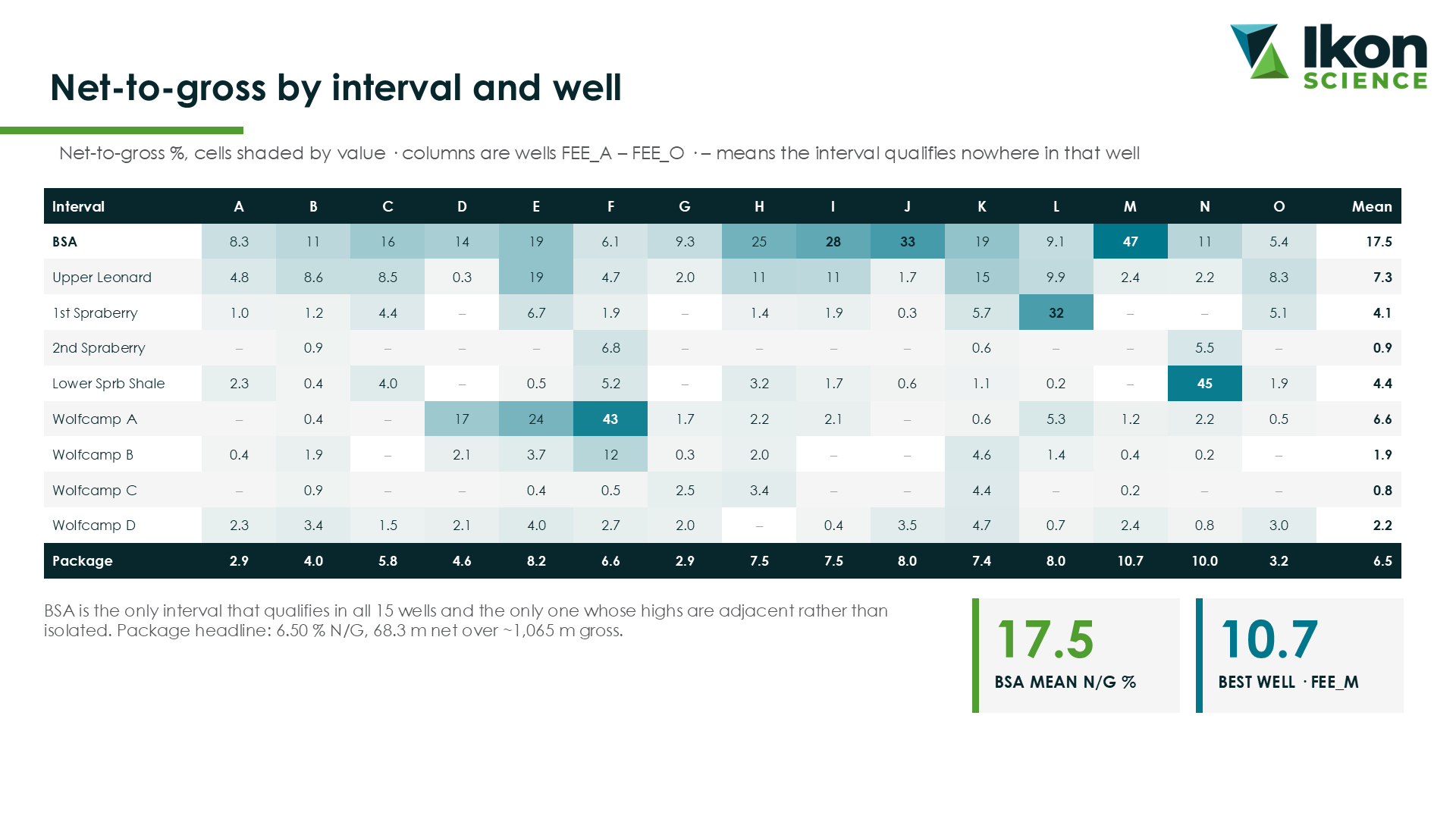
The net-to-gross matrix, intervals down, wells across.
Two things about the result
The map is shown uncropped, with RokDoc's own per well values and the kriging settings still in frame. The calculation, the surface and the picture of the surface all come out of RokDoc, so the thing on the slide is the thing in the project, and leaving the evidence in frame is how you show that rather than assert it.
And three of the nine highs are reported as artefacts. They are single wells flaring on an otherwise empty field, named individually with the reasoning given. That matters more than the highs it endorses, because a map that does not tell you which of its features to distrust is worse than no map: it looks like knowledge.
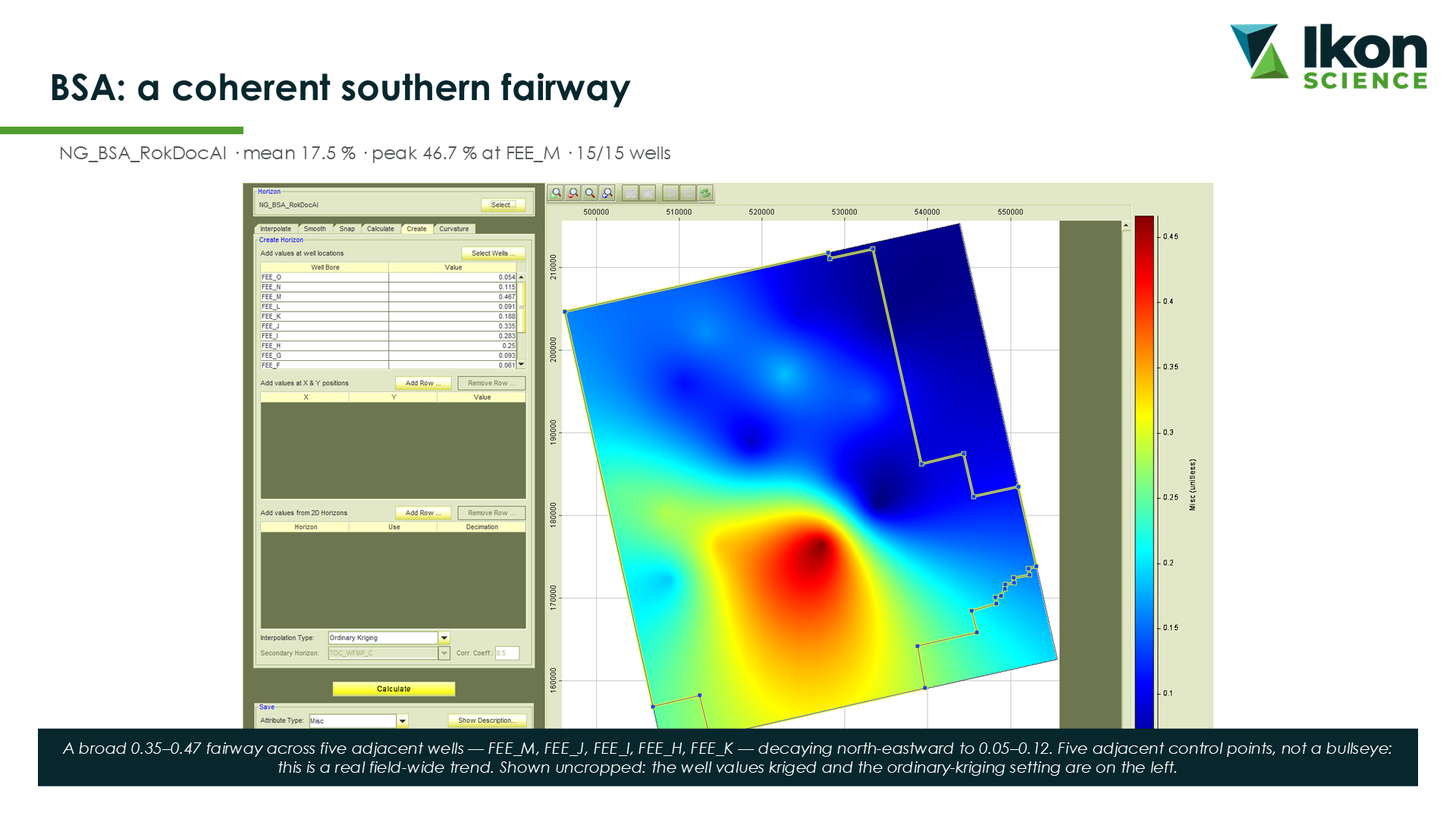
The BSA net-to-gross surface, uncropped, with the Horizon Toolbox beside it.
What is left behind
Ten working intervals and eighteen map horizons, on one shared grid. Not a spreadsheet of results and not a deck describing an analysis. The analysis, where the person who owns the question can move a cut off and run the whole thing again.
Next in the series is the part that surprised us. Instead of driving RokDoc, it extends it.
This post uses an onshore Permian dataset
We hope you found this post insightful. Feel free share your feedback and propose any topics you would like us to explore in future posts. Your input helps us create content that truly resonates with our community.
Thank you for being part of our journey.
Discover More in Part Five
Make the methodology inheritable

Alan Mur has a PhD in Geology with specialization in Geophysics from the University of Pittsburgh and has over a decade of work experience in geology, rock physics, and geophysics. As Product Manager for Quantitative Interpretation (QI) Applications at Ikon Science, he manages all applications related to QI geophysics at Ikon and directs the software development team to evolve Ikon’s software offerings with consideration for the needs of the industry.