


RokDoc 2026.1: Faster, Smarter Reservoir Characterization
Reservoir Characterization workflows in RokDoc 2026.2 concentrate on two goals: getting to answers more quickly and communicating QC more clearly. Reservoir characterization workflows tend to accumulate computational cost in predictable places: seismic conditioning, repeated attribute generation, inversion parameter testing, and the final step of navigating and communicating results across many derived products. This release addresses each of those pressure points. The emphasis is not on changing interpretation philosophy, but on making it easier to apply established methods rigorously across larger datasets and more alternatives.
Structure-oriented filtering that scales better
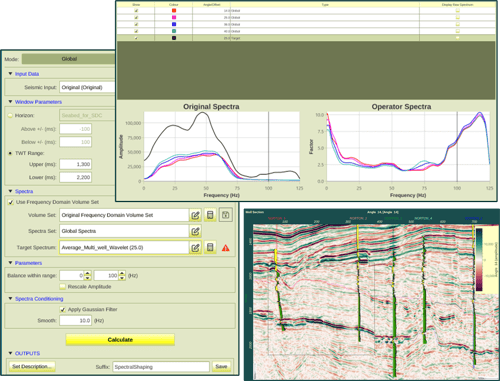
Structure-oriented filtering sits early in many reservoir characterization pipelines because it improves continuity along geologic structure while suppressing incoherent noise that can obscure subtle stratigraphic signals. Performance improvements in the structure-oriented filter reduce turnaround time, with larger gains typically seen for larger step-outs and larger datasets. Practically, this matters when filtering is not a one-time preprocessing step but part of an iterative loop: filter parameters are tuned, results are assessed against known structure and well ties, and downstream attributes are regenerated.
Shorter runtimes change the cadence of QC. It becomes easier to test parameter sensitivity in a disciplined way, rather than selecting a single compromise configuration due to time constraints. For teams that must justify attribute robustness, this also supports more transparent decision-making: parameter choices can be demonstrated rather than asserted.

Faster Intercept and Gradient calculations
AVO-style products often require both careful method selection and the ability to run variants. In this release, performance and memory usage improvements target the SDC Intercept and Gradient function, with the largest improvement observed for the Bar-Wiggins method. The same changes lead to significant improvement in the Petrophysical Reflectivities and AVO Classification functions.
The workflow implication is straightforward: intercept and gradient volumes and derived reflectivities can be generated more efficiently and with less memory pressure. That helps in two common scenarios. The first is exploration-scale screening across large 3D surveys, where runtime and memory can otherwise limit how many variants are computed. The second is appraisal and development contexts, where frequent updates occur as new wells arrive and elastic constraints evolve. Lower memory usage can also reduce session instability in long runs, which matters when results need to be reproducible and auditable.
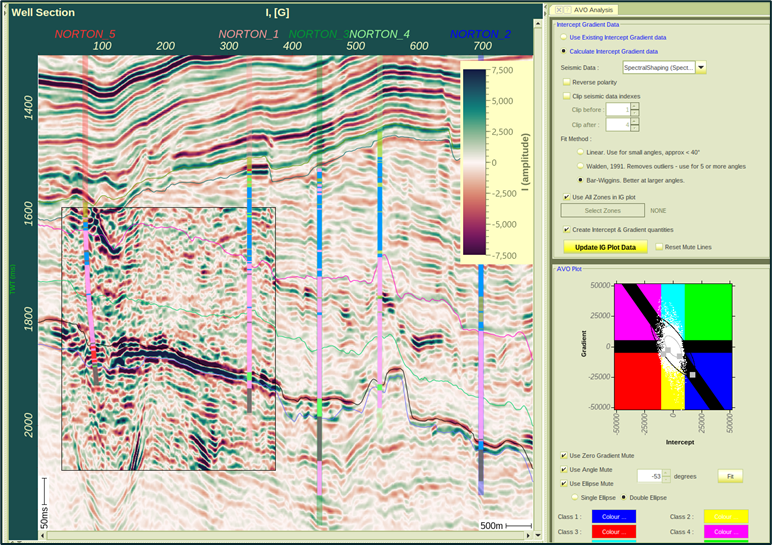
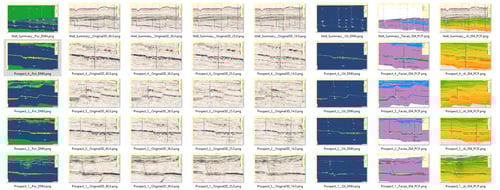
---AVO product generation plus memory usage comparison
Invert Around Wells now supports multiple filters for tighter QC loops
Inversion quality control often comes down to understanding how sensitive the results are to filtering choices, especially near wells where synthetic comparisons provide the most direct validation. Model Based Inversion and Simultaneous Inversion now allow additional filters to be defined within Invert Around Wells, and the effects can be evaluated within the QC well viewer.
This change supports a more methodical inversion workflow. Instead of reconfiguring and rerunning separate setups to compare filter parameterizations, multiple filter options can be reviewed in a consistent QC context around wells. That encourages better practice: sensitivity can be documented, filter choices can be justified, and interpretation teams can align on parameter selections with clearer evidence. The time saved often appears not only in compute, but also in coordination, because fewer “one-off” test runs are needed to reach consensus.
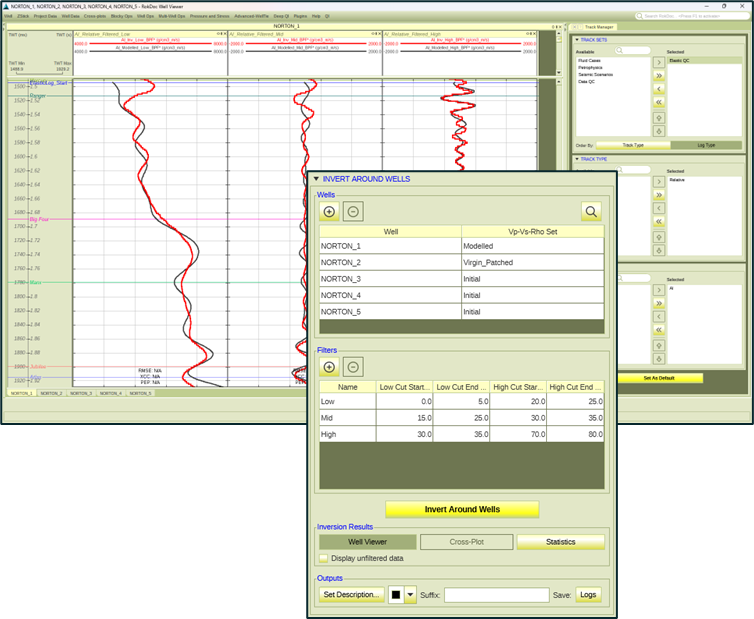
---QC well viewer showing multi-filter definitions and a comparison view of inversion outputs.
As projects mature, map inventories grow quickly: multiple horizons, multiple attributes, repeated processing variants, and derived products from inversion or reflectivity workflows. Two usability updates focus on navigating that complexity.
In the 3D Map Viewer, maps can now be filtered by name and/or by log type, and the UI indicates when a filter is active. In Scene 3D, the map list used for draping onto horizons can now be filtered by log type via a dedicated control, complementing the existing name search. Together, these updates support a more controlled visualization workflow where the focus can be narrowed to the subset relevant to a specific interpretive question, such as reviewing a particular property family across horizons or validating a single attribute lineage.
The business value is often indirect but real. Time spent searching through long lists is time not spent checking geologic consistency or preparing review-ready scenes. Faster scene configuration also improves the pace of technical reviews, where stakeholders commonly request “the same view, but with a different map” in quick succession.
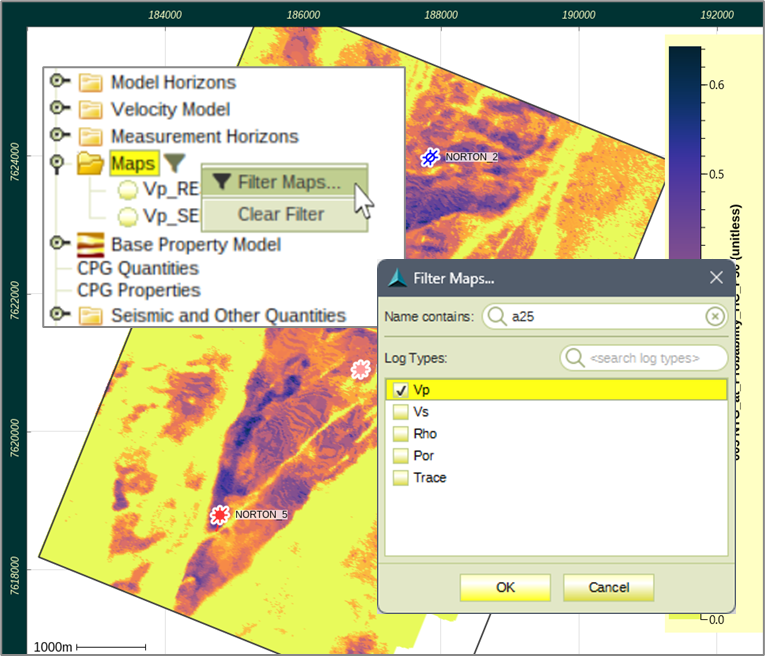
3D Map Viewer filter and the Scene 3D Filter Maps control with log type checklist.
Platform support for large Reservoir Characterisation workloads
Reservoir characterization frequently pushes memory due to large 3D volumes and intermediate results. The platform now caps default memory usage at 60 percent of system RAM, with a configurable percentage via environment variable. In managed environments, this can reduce unpredictable workstation behavior, particularly when multiple applications share resources. While this does not replace good project hygiene, it can improve repeatability for long-running compute steps and exports.
What should the next deep dive cover?
If a follow-on “how-to” would be valuable, suggestions are welcome. Candidates include a technical walkthrough on selecting structure-oriented filter parameters with objective QC criteria, a method-focused explanation of Walden versus Bar-Wiggins choices and recommended validation steps, or a practical guide to designing inversion filter sensitivity tests using the updated Invert Around Wells QC workflow.
If you can share the most common bottleneck in your current reservoir characterization workflow, whether it is conditioning, AVO product generation, inversion QC, or 3D visualization setup, that feedback will help shape the next set of deeper notes. Help us understand your situation by providing us with descriptions of represent real project scale, since the impact of several improvements becomes clearer with realistic map inventories and dataset sizes. How many maps are in your project? How large are your volumes?

Alan Mur has a PhD in Geology with specialization in Geophysics from the University of Pittsburgh and has over a decade of work experience in geology, rock physics, and geophysics. As Product Manager for Quantitative Interpretation (QI) Applications at Ikon Science, he manages all applications related to QI geophysics at Ikon and directs the software development team to evolve Ikon’s software offerings with consideration for the needs of the industry.
.jpg?width=500&height=500&name=output%20(1).jpg)